Painter · Mirror-cut texture
Made to hold light the way water does
Abstract paintings built from paint, texture, and hand-cut mirror. I am Irina Mastov, and I work in Delray Beach, Florida.
“When I cut the mirror, I stop breathing. For a moment I’m not anywhere else — just inside the piece.”
Irina MastovA second reality
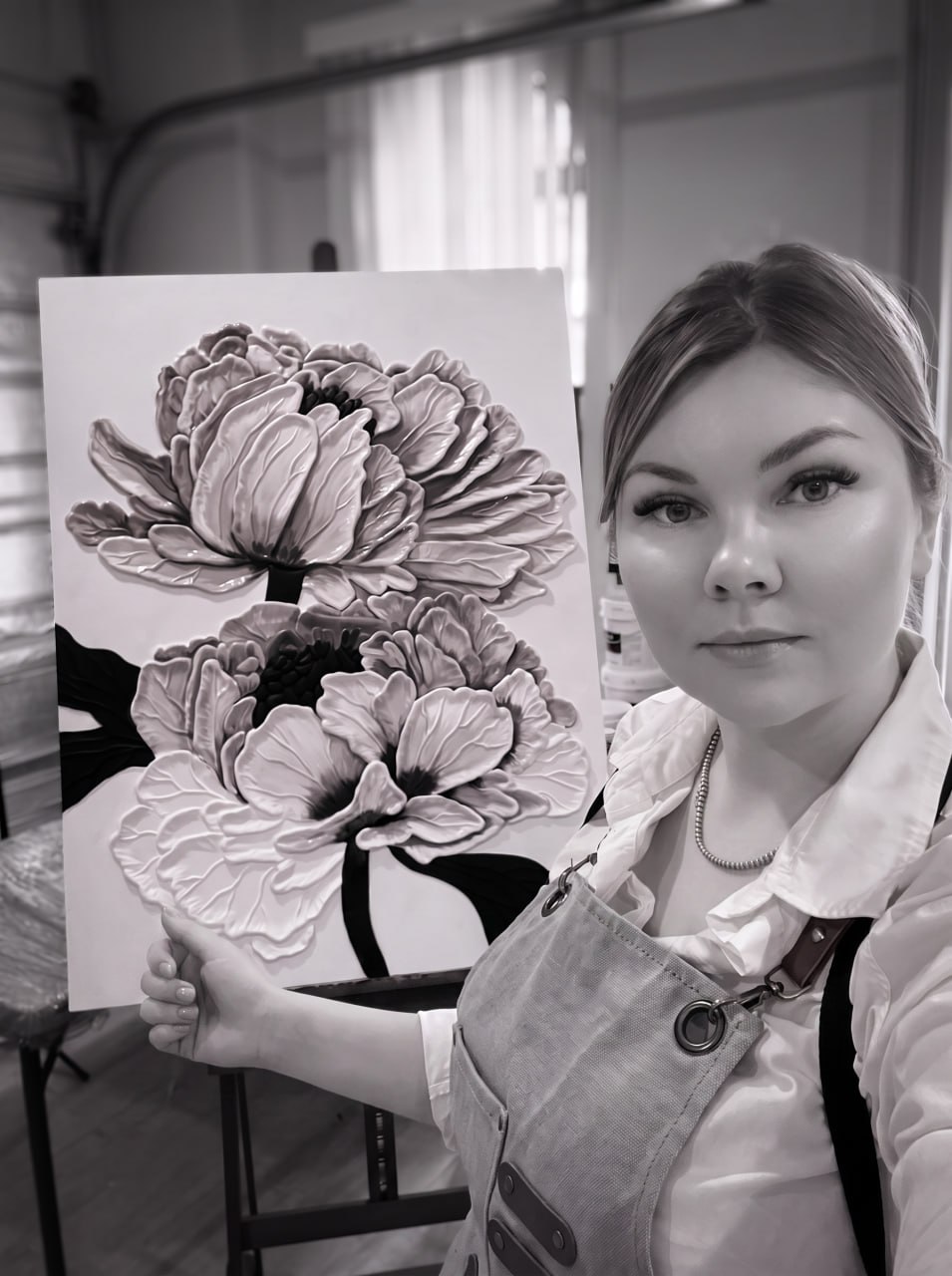
My paintings are where I go when I need to be outside of the outer world. I build them in layers — paint, texture, and glass — until the surface stops being flat and starts holding light the way water does.
I want to make something genuinely beautiful to live with. What I love is the way mirror plays with light: sharp and restless when the sun reaches it, quiet and warm under a lamp in the evening. The same piece gives you two different rooms in one day.
And I want it to be a place I can stand inside for a while, that someone else can recognize as mine before they ever see a signature.
The cut
Mirror-cutting is the part of the process I can’t explain without sounding a little obsessive — because it is. Each shard is scored, snapped, and set by hand into the texture of the piece, so the finished work doesn’t just reflect light, it interrupts it, breaks it, sends it somewhere else.
I don’t plan every fracture. I follow where the glass wants to go, and the painting follows the glass.
Lately I have been setting real crystals into the surface alongside the mirror, a technique I learned recently. Mirror throws light across the room; crystals hold it and break it into colour. Together they give the piece two different ways of answering the sun.
Mirror is the material I keep coming back to, not the only one I use. Some pieces are built from bronze mosaic, some from gold leaf, some from crystal set straight into the surface. What decides it is the kind of light that piece needs to hold.
The weight of old books
I paint with Tolstoy or Dostoevsky running in the background — not for noise, but because their books ask the same question my paintings do: what’s underneath the surface, and what does it cost to look at it honestly.
I’ve never been satisfied just knowing what a novel says. I want to know why it still hurts two hundred years later. I hold my own work to the same standard. A piece that looks finished but says nothing hasn’t really been made yet.
Where it comes from
I keep moving because that’s where I find the thing I end up cutting into the next piece. A coastline, a color of light, a building that shouldn’t work but does. I don’t come home from a trip with souvenirs. I come home with the itch to make something out of what I saw.
How I work
The craft came from the source
Two schools completed in full, both with certificates. The mirror technique I learned in 2024 on the licensed Mirror Master course, taught by Daria Petrik, the artist who developed it.
The whole process is on film
Cutting, layering, the shards that went in the bin. If you want to see how your piece was built, you can watch it happen.
I say so when it will not fit
If your photo tells me a piece is wrong for that wall, I tell you before you pay, and I lose the sale. That is cheaper for both of us than a return.
Nothing is printed
A subject can be built again and it comes out its own way, because hand-cut mirror never falls the same twice. What I will never do is print something and call it original.
I’m still early in turning this into a body of work with its own name attached. The direction is clear: paintings you’d recognize as mine before you ever saw the signature.
Tell me about your wall
Which room, what light reaches it, how much space you have. I will tell you what belongs there, with a price and a date.
Message me on Instagram